While a heat runs, RaceLyx checks every crossing. Anything odd is counted on one line above the live table, labelled Timing. Most of it needs nothing from you. The amber count does: a possible missed read means a driver is quietly a lap down, and you fix it before the heat ends.
Before you start
- A heat running. The Timing line only shows while a heat is on the clock, and only when there is something to report.
Step by step
- 1
A heat on track
Start the heat. Every crossing is checked as it comes in.
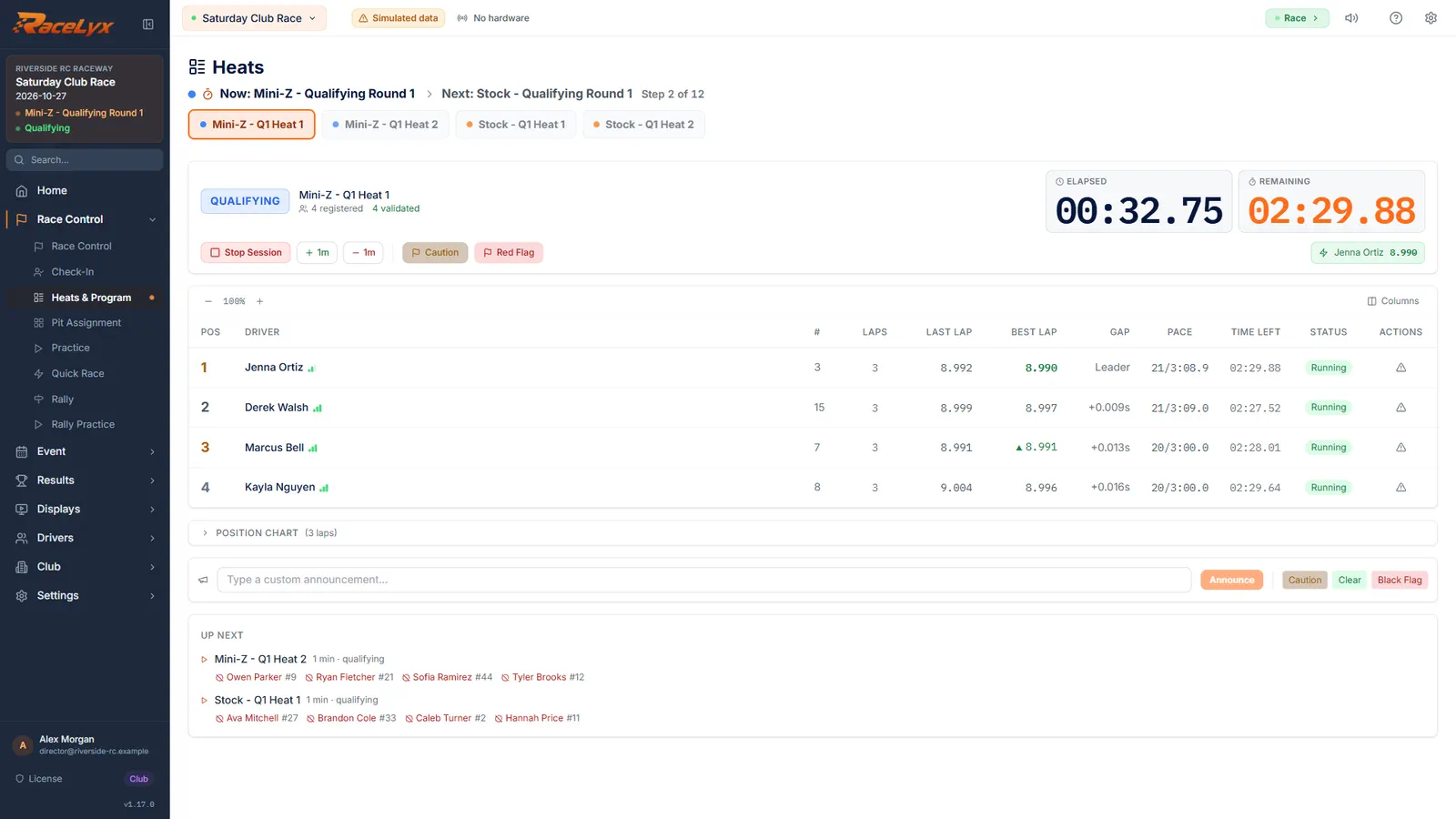
Stage the heat and click Start Race. The cars here lap steadily at about nine seconds, so the Timing line stays hidden: it only appears when there is something to report.
- 2
A crossing goes missing
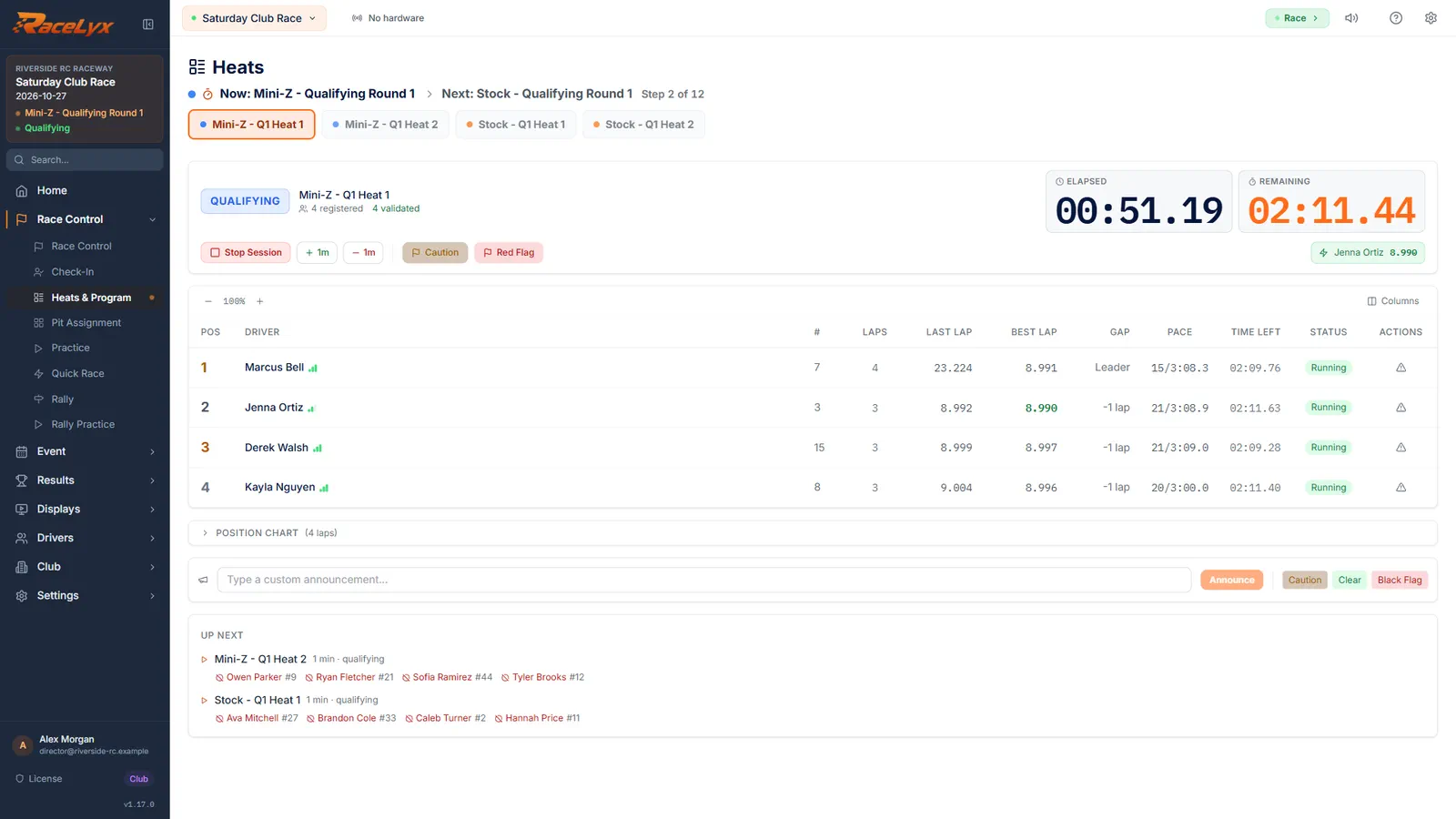
Now the loop misses a crossing. One lap comes in at about twice the driver's normal time.
A missed read happens when a transponder is weak, badly mounted, or crosses at the edge of the loop. The decoder sends nothing, so two laps arrive as one long lap and the driver drops a lap behind without anyone noticing.
- 3
The Timing line
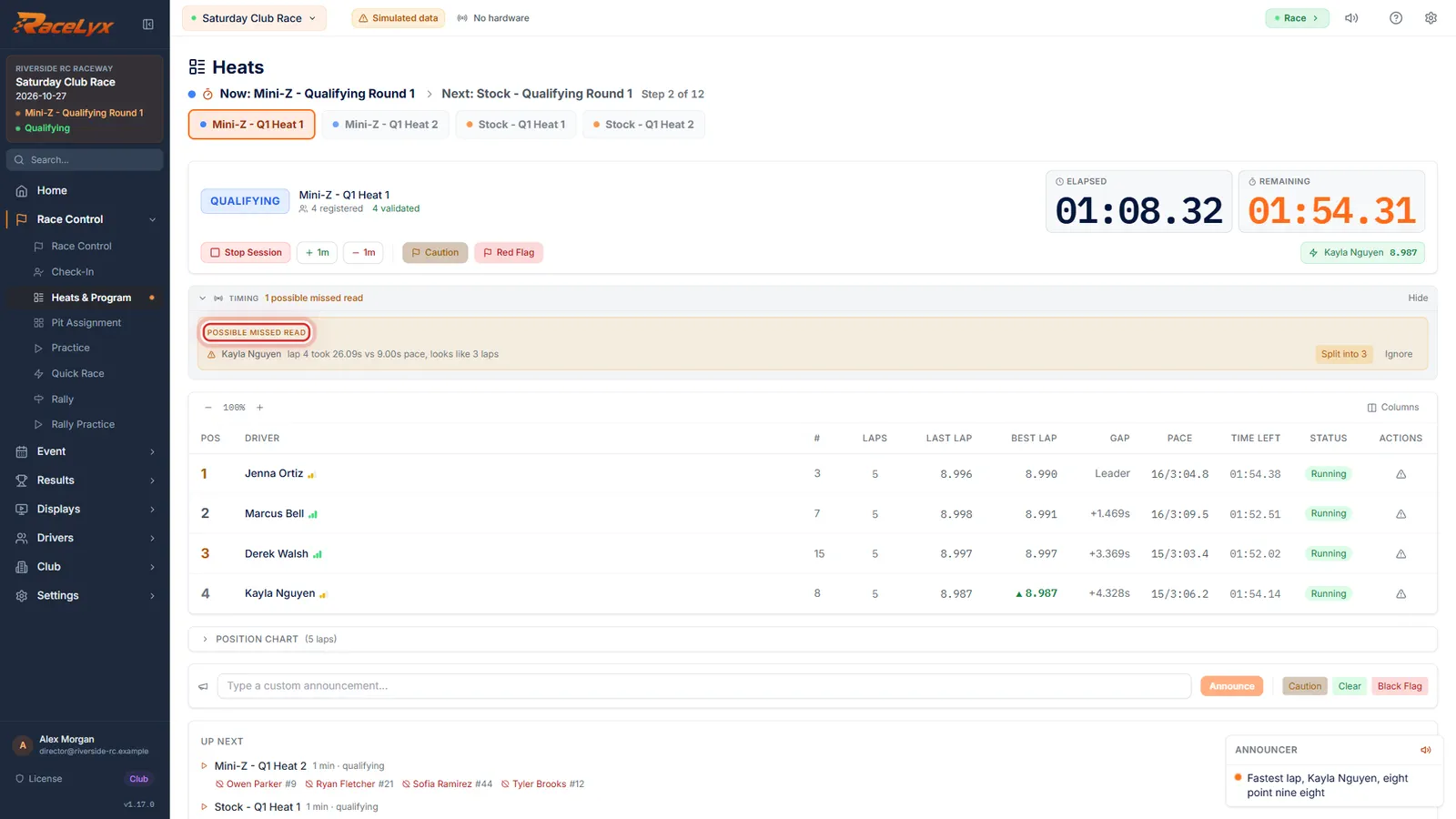
The Timing line appears above the table. The amber count is the one that needs you.
It reads, for example, "1 possible missed read", with Review on the right. Other counts can share the line: rejected laps, duplicate reads, misreads ignored, foreign hits and unregistered cars. Only the amber one needs action.
- 4
Click Review
Click Review. Each suspect lap is listed with the driver, the lap time and their usual pace.
Under Possible Missed Read it says, for example, "lap 4 took 18.20s vs 9.10s pace, looks like 2 laps". The pace is the middle of the driver's earlier laps, so one slow lap does not throw it off.
- 5
Split into 2
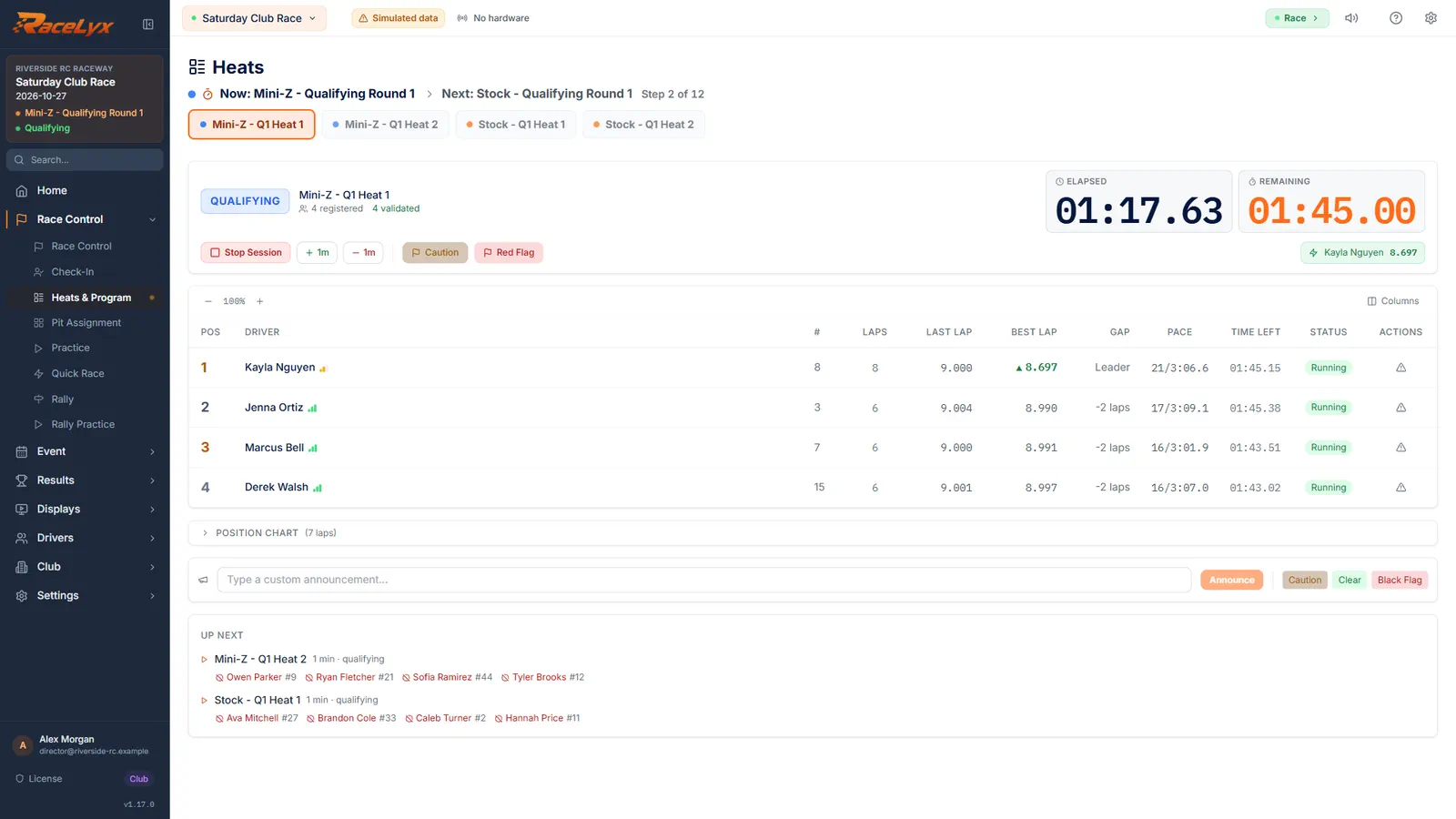
If the lap really is two laps, click Split into 2. The driver gets the lap back, and their total time stays the same.
Split into N cuts the long lap into equal laps and the table re-orders straight away. It is written to the audit log. If the driver crashed or pitted instead, click Ignore and the suggestion goes away.
Tips
- A missed read is a lap about two times a driver's normal lap: the decoder missed one crossing. RaceLyx suggests it from the driver's fourth lap on, for a lap close to 2, 3 or 4 times their usual pace.
- Split into 2 cuts that lap into two equal laps. The driver gains the lap and their total time stays the same.
- Ignore is right when the long lap was real, such as a crash or a trip to the pits. The two look the same, so the call is yours.
- Fix missed reads before the heat ends: the Timing line goes away at the flag. After that, use Edit Laps, or save and use Split lap in Results.
- "rejected lap" is a crossing sooner than the class minimum lap after the last one, usually a double read. It is thrown out on purpose.
- "duplicate read" is the decoder sending the same crossing twice in a moment. RaceLyx filters it.
- "misread ignored" is a crossing with transponder 0 or blank: the decoder could not tell which car. A count that keeps climbing means the loop or a transponder needs a look.
- Stray-car counts can be turned off in Settings, Race: Show unknown transponder alerts during races.
Troubleshooting
- "1 foreign hit".
- A transponder that is not entered in this heat crossed the loop. With Transponder Validation Mode on Strict (the default, in Settings, Race) it is not scored. Clear removes the count.
- "1 unregistered on track", with Assign.
- In Relaxed or Open mode, a car that is not entered is tracked in amber. Click Assign to put that transponder on the right driver: the laps it has done go with it. The icon beside Assign removes it from the race.
- A driver on a borrowed transponder is not being scored.
- In Strict mode there is no Assign during the heat. Save the heat, put the transponder on the driver in Drivers, then rebuild it with Recover a heat or re-run it. Next time, Assign it in roll call before the start.
- "2.10s below min (3.0s)" under Lap Rejected.
- A crossing came sooner than the class minimum lap, so it was not counted. That is what a double read looks like. Nothing to fix.
- "above max (60.0s), baseline reset" under Lap Rejected.
- A lap longer than the maximum lap was dropped and timing restarted from that crossing. In a heat this only happens when a maximum lap is enforced; in practice it is normal.
Related guides
Something here does not match what you see? Tell us and we will fix the guide.